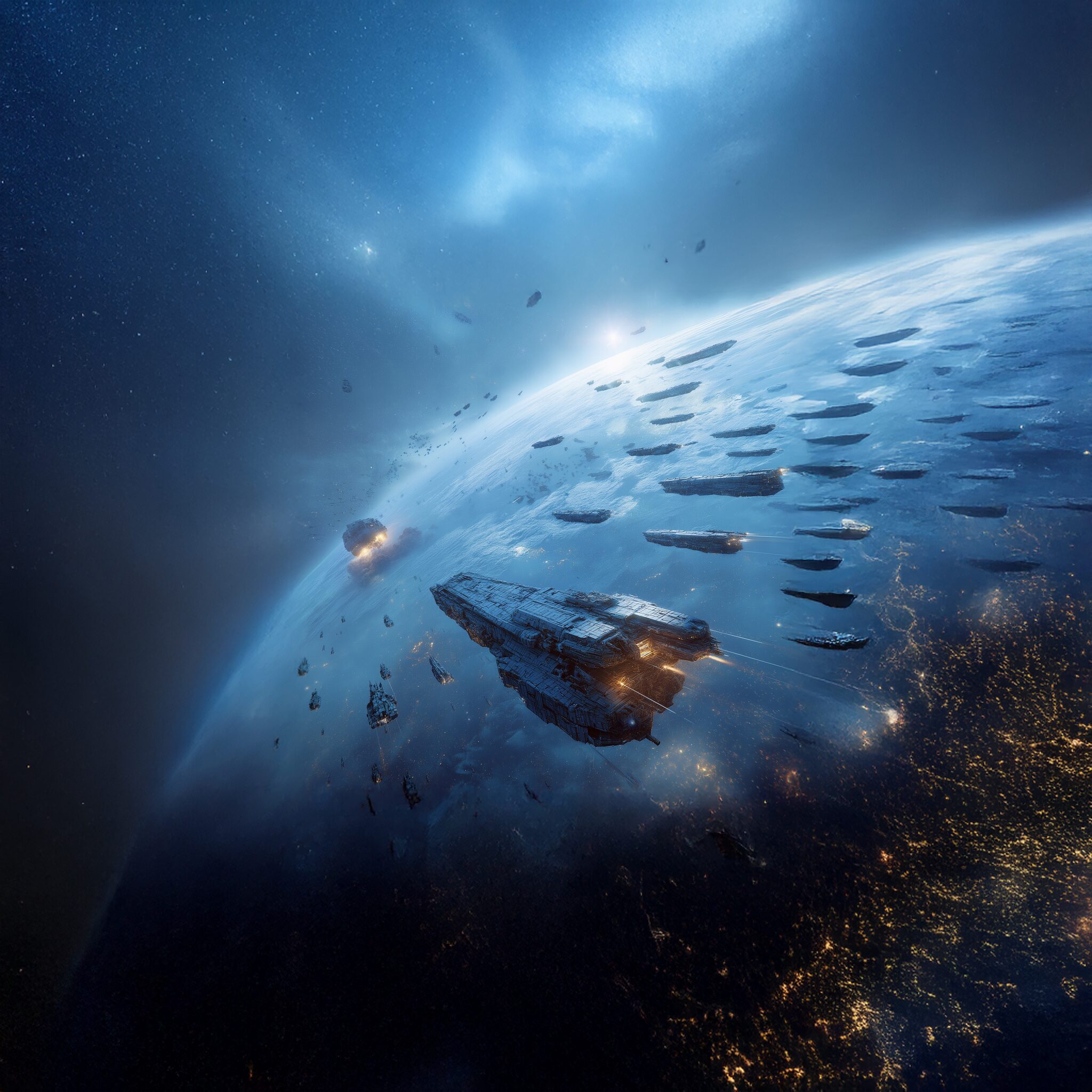
Debris is what is left floating over a slot after a battle. Every ship destroyed in the fight drops part of its build cost into a debris field, and anyone with recycler ships can fly out and pick it up. On a big fight the debris is usually worth more than anything you could plunder off the planet.
Where debris comes from
30 percent of the ore and crystal build cost of every ship destroyed in a battle goes into the debris field over the slot. That counts both sides, the attacker's losses and the defender's.
Three things catch people out:
- Defenses leave nothing. Cannons, missile batteries and the rest create zero debris no matter how many die. On top of that, 70 percent of them are rebuilt free right after the battle, which is why smashing a defense wall never pays for itself.
- Hydrogen never becomes debris. Only ore and crystal. The hydrogen in a dead ship is gone.
- It is worked out per battle. Debris already sitting in the field from an earlier fight is not counted again.
Here is a real report. The two fleets between them lost ships worth 5,150,000 ore and 1,919,500 crystal. 30 percent of that is 1,545,000 ore and 575,850 crystal, which is exactly what the Debris table shows. The 43 Pulse Cannons and 39 Laser Cannons that also died were worth another 316,500 ore and 105,500 crystal and added nothing at all.

Spy probes count as ships. If your Hermes Probes get shot down by counterespionage, 30 percent of their crystal is dropped at the planet you were scouting. A Hermes costs 1,000 crystal, so every one that dies leaves 300 crystal behind.
Finding debris
The Galaxy page has a Debris column. Any slot with a field shows how much ore and crystal is in it. Hover the numbers and you get the exact amounts plus how many recyclers it would take to carry the lot.

- A field has to hold at least 300 ore and crystal combined before it shows up. Anything smaller is still there, it just cannot be seen or harvested until another battle tops it up.
- Debris does not expire. It sits there until somebody hauls it away.
- It belongs to nobody. The first fleet to arrive takes it, whoever created it.
- Debris from a battle over a moon lands in the same slot, so it shows on the planet's row rather than the moon's.
- The Calculator works out the debris a fight would create before you launch it, and tells you how many recyclers to bring.
Harvesting it
Only recycler ships can hold debris. There are two of them.
| Dionysus Class Recycler | Zagreus Class Recycler | |
|---|---|---|
| Cargo capacity | 20,000 | 5,000 |
| Base speed | 2,000 | 3,500 |
| Fuel | 300 | 400 |
| Cost | 10,000 ore 6,000 crystal 2,000 hydrogen | 5,000 ore 3,000 crystal 1,000 hydrogen |
| Needs | Shipyard 4, Jet Drive 6, Shield Tech 2 | Shipyard 2 |
Cargo ships do not help. An Atlas or a Hercules tagging along adds nothing to the haul, because only recycler cargo space is counted when the field is picked up.
The Dionysus is the one to build. Per unit of cargo it costs half as much and burns a fraction of the fuel. One Dionysus carries 20,000 for 10,000 ore, 6,000 crystal, 2,000 hydrogen and 300 fuel. Four Zagreus carry that same 20,000 and cost 20,000 ore, 12,000 crystal, 4,000 hydrogen and 1,600 fuel. The Zagreus is 75 percent faster, so it is only worth it when you are racing somebody else to a field.
Sending the fleet
Three ways in: the Harvest Debris icon on the Galaxy page, the Harvest button at the bottom of a battle report, or picking Harvest on the Fleets page. All three land on the same screen, which lists your recyclers and nothing else. Auto fills in the right number for the field you are aiming at. A harvest uses a fleet slot like any other mission.

The Fleet Save button on that screen opens up the rest of your fleet. That is there so you can hide your whole fleet on a harvest run, see Fleet / Resource Saving. Those extra ships still hold none of the debris.
When you cannot carry it all
If your recyclers cannot lift the whole field, the game takes an even amount of ore and crystal first, then fills whatever room is left with whichever of the two there is more of.
- Field of 424,800 ore and 207,150 crystal, 500,000 of cargo space. You take 207,150 of each, that is 414,300, then the last 85,700 comes out of the ore. You get home with 292,850 ore and 207,150 crystal.
- Field of 10,900,000 ore and 5,000,000 crystal, 2,000,000 of cargo space. You get 1,000,000 of each. Turning up short means a straight 50/50 split, not a share that matches the field.
The rest stays in orbit for the next fleet. Send enough recyclers and the field is emptied and disappears.
One gotcha: a planet that has used Move Planet in the last 24 hours can still send recyclers, but they arrive and collect nothing. The report says so and the field is left untouched for somebody else.
Moons
Any battle that creates debris also rolls for a moon at the target. The chance is that battle's debris divided by 15,000,000.
| Debris in the battle | Moon chance |
|---|---|
| under 150,000 | no roll at all |
| 150,000 | 1% |
| 750,000 | 5% |
| 1,500,000 | 10% |
| 3,000,000 or more | 20%, the cap |
The report prints the number whether the moon forms or not. Below 1 percent it stays quiet and the section does not appear.

The parts people get wrong:
- The moon goes to the defender. Blow up a fleet over somebody's planet and the moon that pops out belongs to them, not to you.
- Only that battle's debris counts. Debris already floating there does nothing for the roll, so you cannot seed a slot with one big fight and then farm the chance with a string of small ones.
- The moon does not eat the debris. It forms and the debris is still sitting there to be harvested.
- One moon per slot. If the slot already has a moon there is no roll.
- The defender has to be a planet. Attacking a moon never creates a moon, and NPCs never gain one.
- A bigger chance makes a bigger moon. A 1 percent roll gives you something around 3,600 km with about 36 fields. A 20 percent roll is closer to 8,900 km and about 89 fields.
Making debris on purpose
Plenty of attacks are launched for the debris rather than the loot. Plunder is 50 percent of what happens to be sitting on the planet, and you can only carry home what your cargo space holds. Debris is 30 percent of a whole fleet's build cost and it does not care how empty the planet was. Catch a fleet worth 10,000,000 in ore and crystal on the ground and there is 3,000,000 floating over the slot afterwards.
Two things to plan for:
- Recyclers are slow and they have no business sitting in orbit while the shooting happens. Send them behind the attack, timed to land after it, or make a second trip.
- Anyone can take it. Smash a fleet deep in somebody else's space and take an hour to get recyclers out there, and expect to find the field already gone.
It cuts both ways. Your own losses go into the same field, so if you lose the fight the winner harvests your ships along with theirs.
Comments
No comments yet.
Sign in to leave a comment.