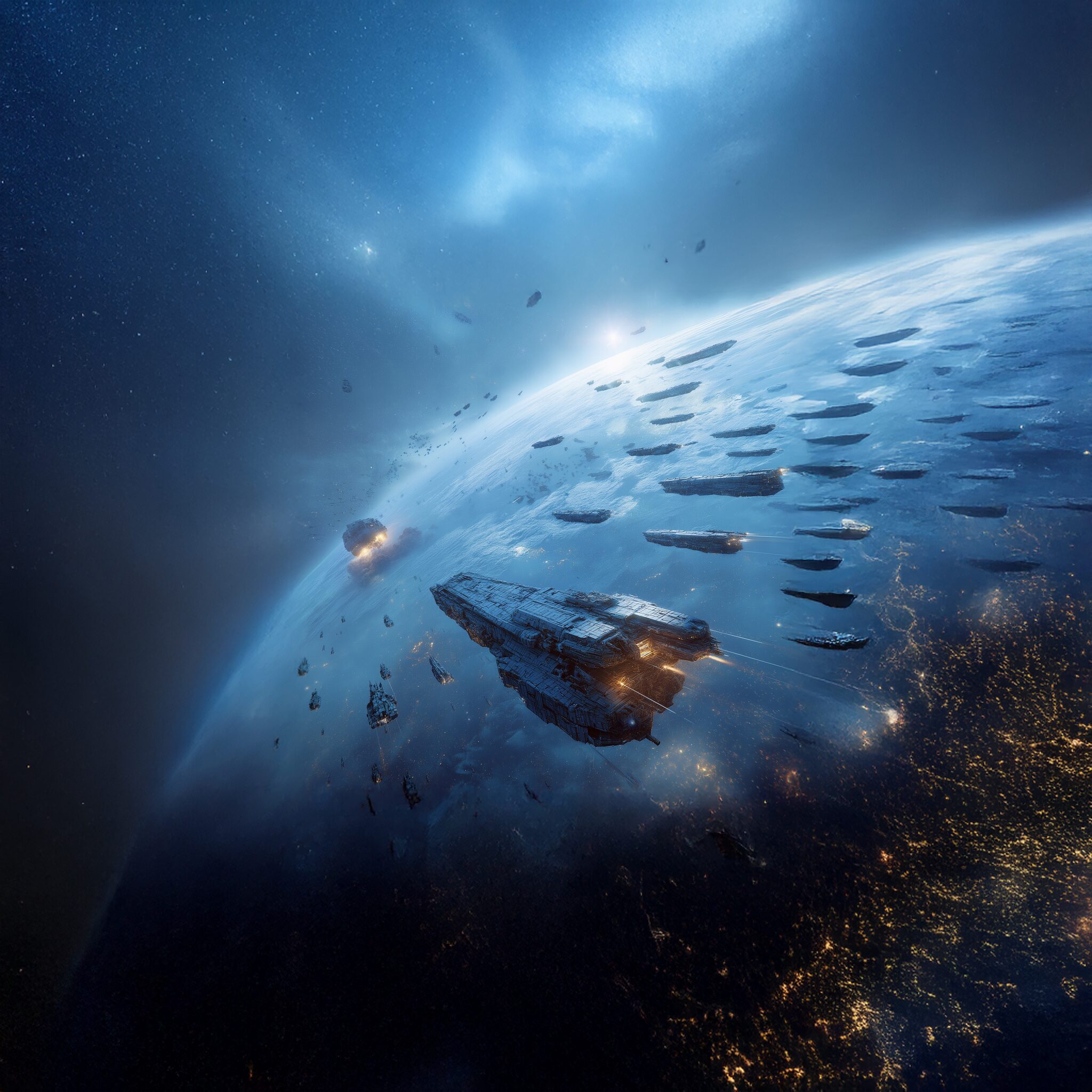
Fodder is cheap stuff you bring to a battle so the enemy shoots it instead of the ships you care about. It works because nothing in an SFC2 battle aims. Every shot picks a target at random from everything the other side still has alive, so the more separate things you own on the field, the smaller the share of incoming fire that lands on anything expensive.
The same trick works both ways. An attacker screens a battle fleet with cheap hulls. A defender screens the expensive turrets with a wall of cheap ones. The word comes from "cannon fodder", troops sent forward to soak damage for the ones behind them.
Why it works
Four rules from the battle engine are all you need:
- Targets are picked at random. Every unit fires once a round at a random surviving enemy. Ships and defenses are one pool, so a shot can land on a parked cargo ship just as easily as on a Plasma Cannon.
- A battle is at most six rounds. Survive the six and it is a draw, and a draw sends the attacker home with nothing.
- A round is simultaneous. Both sides fire in full before anything is removed, so a fodder ship that was blown apart early in the round keeps eating shots for the rest of it. Overkill lands on the cheap stuff too.
- Shields refill every round, hull damage does not. A screen of small hulls buys you six full rounds of the enemy wasting fire.
The arithmetic is not about hull points. It is about how many separate objects the enemy has to choose from. Sixty thousand resources buys you one Athena Class Battleship or fifteen Artemis Class Fighters. Fifteen Artemis are fifteen chances for the enemy to waste a shot. Put 1,000 Artemis in front of 100 Athena and only one shot in eleven lands on an Athena.
Fodder in an attack fleet
Anything cheap with a hull will do the job. What matters is resources per body, not how tough the body is.
| Ship | Cost | Hull | Attack | Bodies per 1M | Rapid fired by | |
|---|---|---|---|---|---|---|

| Hermes Class Probe | 1,000 | 100 | 0 | 1,000 | every armed ship, x5 |

| Artemis Class Fighter | 4,000 | 400 | 50 | 250 | Poseidon x6 |

| Atlas Class Cargo | 4,000 | 400 | 5 | 250 | Apollo x3, Hades x3 |

| Apollo Class Fighter | 8,500 | 850 | 150 | 118 | Hades x4 |

| Hercules Class Cargo | 12,000 | 1,200 | 5 | 83 | Hades x3 |
Cost is ore plus crystal plus hydrogen added together. The Zeus Class rapid fires every one of them at ratings from x100 to x1250 and is left out of the table, because nothing is fodder against a Zeus.
The Artemis is the default answer. It is the cheapest body that also shoots back, and only the Poseidon Class Cruiser has rapid fire against it. The Atlas costs the same and brings 5,000 cargo, but its 5 attack is so low that it bounces harmlessly off anything with a big shield, and both the Apollo and the Hades chew through it.
What it actually saves you
Both runs below came out of the in-game Calculator, against the same wall of 400 Laser Cannon, 200 Pulse Cannon and 40 Gauss Cannon, with Weapons, Shield and Armor at 10 on both sides.
First, 100 Athena on their own:

All 100 die, six million resources gone, and the wall survives with most of it still standing. Now the same 100 Athena with 1,000 Artemis in front of them, four million more spent:

Two Athena lost instead of 100. The whole wall is destroyed. Total losses drop from six million to 2.7 million even though the fleet cost more to build, and the fleet flies home instead of dying on the field. That is the whole case for fodder in one pair of pictures.
Rapid fire is the trap
A ship with rapid fire against your fodder does not get held up by it. It shoots, rolls for a free shot at a fresh random target, and keeps going until a roll fails. At x5 that is an 80 percent chance of another shot, at x20 it is 95 percent. A screen the enemy rapid fires is worse than no screen at all, because you paid for it and it barely absorbed anything.
So the right fodder depends on what you are flying at. Against 300 Poseidon, two six million fleets built the same way apart from the screen:
| Attacking fleet | Result | Poseidon killed | What came home |
|---|---|---|---|
| 60 Athena + 600 Artemis | defender wins, round 4 | about 79 | nothing |
| 60 Athena + 600 Atlas | draw on round 6 | about 149 | about 24 Athena |
The Poseidon rapid fires the Artemis at x6 and has nothing at all against the Atlas, and that single line in the rapid fire table is worth almost double the damage for the same spend. The Hades is the mirror image: it tears through Atlas, Apollo and Hercules and has nothing against the Artemis. Spy the target first and pick the screen to suit.
The other one to know: every armed ship in the game rapid fires probes and satellites at x5. They are the cheapest bodies there are, and against a real fleet they evaporate in a round.
What fodder costs you
- Hydrogen. The 1,000 Artemis above added about 4,800 hydrogen to the trip.
- Time. The Artemis runs on Jet Drive while the big warships run on Warp Drive, and Warp Drive is worth 30 percent a level against Jet Drive's 10 percent. A few levels in, your battleships are faster than your fodder and the whole fleet slows to the fodder's pace. In the run above the trip went from 26:32 to 29:30. The Atlas is worse: it sits at 5,000 base speed until Pulse Drive 5, when its engine swaps and its speed doubles.
- Points for the other guy. Every fodder ship that dies is destroyed ships points for whoever shot it down, and 30 percent of what it cost turns into debris sitting over the target for them to harvest.
- Shipyard time. A thousand Artemis is a long queue. Build them between raids, not the night before one.
None of that changes the answer, but it is why you screen a real target and not a bare planet.
Fodder on defense
The defending side plays the same game with cheap turrets, and it is even better value there for two reasons that have nothing to do with targeting:
- Destroyed defenses leave no debris. The attacker gets nothing to harvest off your wall no matter how much of it dies.
- About 70 percent of destroyed defenses are rebuilt for free the moment the battle ends. A turret wall really costs you around 30 percent of its losses.
| Defense | Cost | Hull | Shield | Attack | Bodies per 1M | Rapid fired by |
|---|---|---|---|---|---|---|
| Missile Battery | 2,000 | 200 | 20 | 80 | 500 | Ares x20, Poseidon x10 |
| Laser Cannon | 2,000 | 200 | 25 | 100 | 500 | Ares x20, Prometheus x10 |
| Pulse Cannon | 8,000 | 800 | 100 | 250 | 125 | Ares x10 |
| Particle Cannon | 8,000 | 800 | 500 | 150 | 125 | Ares x10 |
| Gauss Cannon | 37,000 | 3,500 | 200 | 1,100 | 27 | nothing but a Zeus |
| Plasma Cannon | 130,000 | 10,000 | 300 | 3,000 | 7 | nothing at all |
The Missile Battery and the Laser Cannon are the fodder. At 2,000 each they are 500 bodies per million and they still fire back. The Pulse and Particle Cannons are four times the price for one body each, so treat those as guns rather than as a screen. Both cheap turrets are rapid fired hard by the Ares Class Bomber, which is exactly what an Ares is for.
What a screen does to an attacker
Same Calculator, both sides at tech 10, attacker is 140 Athena. First, 20 Plasma Cannon and 50 Gauss Cannon with nothing in front of them:

The attacker walks it in four rounds for 43 Athena and takes the plunder. Now add 800 Missile Batteries, 1.6 million resources on top of a 4.45 million wall:

Every one of the 140 Athena dies, 8.4 million gone, and the defense loses no Plasma Cannon, three Gauss Cannon and 388 Missile Batteries. Around 270 of those Missile Batteries come straight back, so the real bill for holding the planet is roughly a quarter of a million resources against an 8.4 million fleet.
Cheap turrets are the best value in the game right up until somebody shows up with an Ares wing, and even then they cost the attacker something to clear.
Decoys are not fodder
The Decoy and the Large Decoy look like fodder and are not, because you can only ever have one of each on a planet. Two extra bodies in a wall of hundreds changes nothing about the targeting maths.
What they do is soak. Nothing in the game has rapid fire against either of them, and their shields refill every round: 2,000 on the Decoy and 10,000 on the Large Decoy. Anything doing 1 percent of that or less bounces off completely, so at matched tech levels an Artemis cannot scratch a Large Decoy at all. Build them for the shield pool, not for the body count.
Things people mistake for fodder
- Solar satellites. Your Helios and Genesis satellites sit on the planet, so they join the battle whether you want them to or not, and every armed ship rapid fires them at x5. They are power plants that happen to die in battles. Genesis satellites at least come back at the same 70 percent rate as defenses.
- Parked ships. Anything sitting on the planet when an attack lands is a target, including your haulers and recyclers. That is not a screen, that is a loss. Fleet save instead.
- Probes against a fleet. A Hermes Class Probe is the cheapest body in the game at 1,000 crystal, and no defense rapid fires anything, so against a bare turret wall it is the most efficient screen there is. Against anything with warships in it, every one of those warships rapid fires it at x5 and the screen is gone in a round.
- Credit ships. A Shadow Probe costs 20,000 credits. Fodder is meant to be thrown away. Do not throw away things you paid money for.
Work it out first
Do not guess the ratio. SFC2 has a battle Calculator in the More menu that runs the same engine the real battles run. Spy the target, type both fleets in, then try it with and without the screen and read the losses. Every number on this page came out of it, and it costs nothing to be wrong there instead of on the field.
See also: Combat, Rapid Fire, Attack fleet construction guide, Defenses.
Comments
No comments yet.
Sign in to leave a comment.