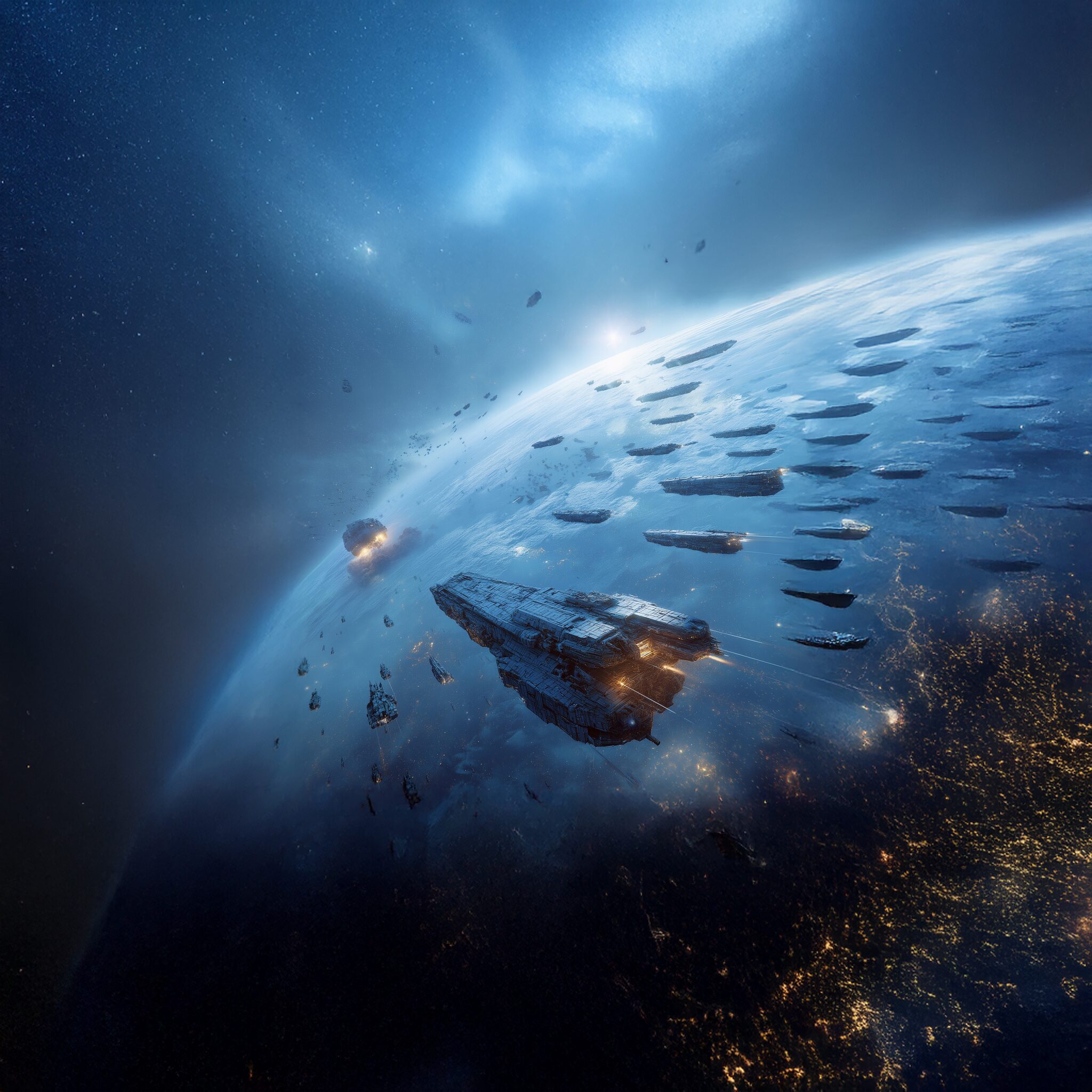
An attack fleet in SFC2 is never one ship type. It is three jobs done by three different kinds of hull: something that shoots, something cheap for the enemy to shoot at, and something to carry the loot home. Build only the first and you will lose ships you did not need to lose.
This page is about what to build and why. For the raw stats on any single ship, see Ships or that ship's own page.
How a battle actually works
Five rules decide everything below. They are worth learning before you spend a single resource.
- A battle runs a maximum of six rounds. If both sides still have something alive after round six it is a draw, and a draw means the attacker flies home with nothing.
- Every unit fires once per round, and it picks its target at random from every enemy unit still alive. Nothing aims. This is the most important rule on the page, and it is the whole reason fodder works.
- Rapid fire gives a ship extra shots in the same round against specific targets. The chance of another shot is (rating minus 1) divided by rating, so x20 is 95 percent, x7 is 86 percent and x3 is 67 percent.
- Shields reset at the start of every round. Hull damage does not. A shield is a fresh damage pool six times per battle, which is why lots of small shots get eaten and a few big ones do not.
- A shot that does 1 percent or less of the target's full shield bounces and does nothing at all. A Missile Battery cannot scratch a Zeus no matter how many you stack.
One more, at the end of each round: a unit that has lost more than 30 percent of its hull can blow up, at a chance equal to how damaged it is. A ship on 50 percent hull has a 50 percent chance of exploding whether or not anything hits it again.
The three jobs
Guns
These are the ships that kill things. Which one you want depends entirely on what you are flying at.
| Ship | Cost | Attack | Hull | Rapid fire against things that shoot back | |
|---|---|---|---|---|---|

| Artemis Class Fighter | 4,000 | 50 | 400 | none |

| Apollo Class Fighter | 8,500 | 150 | 850 | Atlas x3 |

| Poseidon Class Cruiser | 29,000 | 400 | 2,700 | Artemis x6, Missile Battery x10 |

| Athena Class Battleship | 60,000 | 1,000 | 6,000 | none |

| Hades Class Battleship | 85,000 | 700 | 7,000 | Athena x7, Apollo x4, Poseidon x4, Atlas x3, Hercules x3, Carmanor x2 |

| Ares Class Bomber | 90,000 | 1,000 | 7,500 | Missile Battery x20, Laser x20, Particle x10, Pulse x10 |

| Prometheus Class Destroyer | 125,000 | 2,000 | 11,000 | Hades x2, Laser x10 |

| Zeus Class | 10,000,000 | 200,000 | 900,000 | nearly everything |
Cost is ore plus crystal plus hydrogen added together. Attack and hull are base values before Weapons Tech and Armor Tech, which each add 10 percent of base per level.
Fodder
Because targeting is random, a fleet with 2,000 units in it takes the same number of shots per round as a fleet with 200 units, but each shot is far more likely to land on something cheap. Fodder is not about hull points, it is about how many separate things the enemy has to pick from.
Sixty thousand resources buys one Athena or fifteen Artemis. Fifteen Artemis are fifteen chances the enemy wastes a shot. That is the entire trick.
The Artemis is the best fodder in the game. The Apollo is tougher and actually contributes damage, but the Hades rapid fires it at x4 while it has nothing against the Artemis, so against a Hades fleet the Artemis is the better buy. Watch out for the Poseidon, which rapid fires the Artemis at x6.
Haulers
A win with no cargo space is a wasted trip. You plunder 50 percent of what is sitting on the planet, 55 percent if your alliance is at war with theirs, and only surviving ships carry it.
| Ship | Cost | Cargo | Base speed | Notes | |
|---|---|---|---|---|---|

| Atlas Class Cargo | 4,000 | 5,000 | 5,000 on Jet Drive | Doubles to 10,000 base at Pulse Drive 5, and burns twice the fuel from then on |

| Hercules Class Cargo | 12,000 | 25,000 | 7,500 on Jet Drive | Never upgrades its engine, so a Pulse-era Atlas outruns it |

| Carmanor Class Cargo | 36,000 | 125,000 | 4,000 on Jet Drive | Slowest hull you can put in a fleet. Keep it off raids |
Cargo per resource spent: Atlas 1.25, Hercules 2.08, Carmanor 3.47. The Carmanor is by far the most efficient hauler and by far the worst raider, because a fleet only moves as fast as its slowest ship. Bring Hercules on raids, use the Carmanor for moving resources between your own planets.
Warships carry a little too, and it adds up. An Athena holds 1,500, a Prometheus 2,000, a Poseidon 800 and an Artemis 50. Four hundred Artemis is another 20,000 of cargo you did not have to pay for.
Eyes
The Hermes Class Probe costs 1,000 crystal, arrives almost instantly and tells you what is on a planet before you commit. Never launch an attack you have not spied first. Probes cannot carry plunder, so they are dead weight in the attack fleet itself. Send them separately.
Test the fleet before you build it
SFC2 ships with a battle Calculator. It is in the More menu, and it runs the same engine the real battles run. Type a fleet, type what you think is on the other end, hit Simulate. It is free, it is instant, and it will save you more resources than any advice on this page.
Every run quoted below was done in the Calculator with Weapons, Shield and Armor at 10 on both sides. Results move a little from run to run, so where a range is given that is the spread over several tries.
Against a defended planet
Defender: 250 Missile Battery, 150 Laser Cannon, 60 Pulse Cannon, 40 Particle Cannon, 15 Gauss Cannon, 5 Plasma Cannon. That is 2.8 million of turrets. Every attacking fleet below costs about 6 million.
| Attacking fleet | Result | What it costs you |
|---|---|---|
| 100 Athena | draw on round 6, wall still standing | about 68 Athena, 4.1 million |
| 1,500 Artemis | draw, or a bare win on round 6 | about 360 Artemis, 1.4 million |
| 50 Athena + 750 Artemis | draw on round 6 | about 455 Artemis and a few Athena, 2.0 million |
| 67 Ares | clean win in 3 rounds | about 9 Ares, 850,000 |
| 33 Ares + 750 Artemis | clean win in 4 or 5 rounds | about 230 Artemis and usually no Ares at all, 930,000 |
Same money five ways, and the spread is four to one. Battleships are the wrong tool against turrets: the Athena has no rapid fire and 520 turrets get 520 shots a round back at only 100 targets. The Ares rapid fires four of the six turret types, and the Artemis in front of it soak the return fire.
Two things to know before you go turret hunting. Defenses leave no debris, and about 70 percent of everything you destroy is rebuilt for free right after the battle. Breaking a wall is how you get at what is behind it. It never pays for itself.
Against a fleet
Defender: 200 Athena, 500 Artemis, 100 Apollo, 60 Poseidon, 16.6 million all in. Attacking fleets cost about the same.
| Attacking fleet | Enemy resources destroyed | Your resources lost |
|---|---|---|
| 277 Athena | 5.3 to 6.6 million | all 16.5 million |
| 195 Hades | 4.5 to 5.8 million | all 16.6 million |
| 133 Prometheus | 4.5 to 4.9 million | all 16.6 million |
| 138 Athena + 2,075 Artemis | 8.3 to 9.4 million | 7.6 to 8.1 million |
| 286 Poseidon + 2,075 Artemis | 10.1 to 10.8 million | 8.2 to 8.4 million |
| 97 Hades + 2,075 Artemis | 16.2 to 16.5 million | 7.1 to 7.6 million |
Every pure fleet in that list is wiped out to the last hull. Every mixed fleet walks away. Spending half your budget on the cheapest ship in the game roughly doubles what you kill and halves what you lose.
The bottom line is the same 16.6 million as the others. It wins that hard because the defender is Athena heavy and the Hades rapid fires the Athena at x7. Spy first, then pick the gun that counters what they actually own.
A whole raid, start to finish
Same turret wall as above, this time with 2.4 million ore, 1.2 million crystal and 400,000 hydrogen sitting on the planet. Attacking fleet: 33 Ares, 750 Artemis and 85 Hercules for the cargo.

Plunder is capped at half of what is there, so 4 million on the ground pays out just under 2 million. The 85 Hercules were sized to carry it, and the Calculator flags the shortfall for you when you are short. Ship losses came to 1,054,000, most of it Artemis. Net gain 1.2 million, plus 311,700 of your own wreckage waiting in the debris field if you send recyclers.
The Den Lvl box on the defender side matters too. A Resource Den hides a fixed amount of each resource from plunder, and a big one can turn a fat target into a dry one.
Building the ships
Everything is built on the Shipyard page of whichever planet you are standing on. Ships built on Calder stay on Calder until you fly them somewhere, so pick one planet to be your fleet planet and put the Shipyard levels and the Foundry there.

The Base column is the ship as designed. The Current column is what your research has done to it. The commander above is running Weapons 9, Shield 8, Armor 11 and Warp Drive 8, which is why the Ares reads 4,000 base speed and 17,000 current: Warp Drive 8 is the level where the Ares swaps its Pulse Drive for a Warp Drive.
The More Info button on any row opens the full sheet, including both rapid fire lists. Read those before you commit to a hull.

Notes on each ship
Artemis Class Fighter
3,000 ore and 1,000 crystal at Shipyard 1 and Jet Drive 1. You start the game with two of them. It is the cheapest hull in the game and the reason every fleet on this page wins: it is a target the enemy can waste a shot on for 4,000 resources. There is no hydrogen in the build, so you can turn them out from ore and crystal alone. Only the Poseidon (x6) and the Zeus (x200) rapid fire it.
Apollo Class Fighter
6,000 ore and 2,500 crystal at Shipyard 3, Pulse Drive 2 and Armor Tech 2. Three times the attack and twice the hull of an Artemis for a little over twice the price, and it rapid fires the Atlas at x3, which makes it a genuine deterrent against early cargo raids. As fodder it is worse than the Artemis against anyone flying a Hades, because the Hades rapid fires it at x4.
Poseidon Class Cruiser
20,000 ore, 7,000 crystal and 2,000 hydrogen at Shipyard 5, Pulse Drive 4 and Particle Tech 2. Base speed 15,000, the highest of any warship, so it is usually the fastest thing you own. Its rapid fire is narrow but well aimed: Artemis at x6 and Missile Battery at x10. Against a player who defends with cheap fighters and missile batteries the Poseidon is excellent value. Against anything heavier it is thin, and the Hades rapid fires it at x4.
Because it runs on Pulse Drive and the big battleships run on Warp Drive, the Athena and Hades will overtake it once your Warp Drive is roughly two levels above your Pulse Drive.
Athena Class Battleship
45,000 ore and 15,000 crystal at Shipyard 7 and Warp Drive 4. No hydrogen at all, which is what makes it the ship most large fleets are built around: hydrogen is the resource you are always short of. It hits for 1,000, carries 1,500 and has the cheapest firepower per resource of any heavy ship.
The catch is that it has no rapid fire against anything that shoots back, and the Hades rapid fires it at x7. An Athena wall on its own loses to almost anything of equal cost. Put Artemis in front of it and it is the best value in the game.
Hades Class Battleship
30,000 ore, 40,000 crystal and 15,000 hydrogen at Shipyard 8, FTL Tech 5, Warp Drive 5 and Laser Tech 12. This is the fleet killer. It rapid fires the Athena at x7, the Apollo and Poseidon at x4, the Atlas and Hercules at x3 and the Carmanor at x2, which covers most of what an ordinary player flies.
Its attack of 700 is low for its price and its shield of 400 is behind both the Ares and the Prometheus at 500. You are not buying damage, you are buying extra shots. Only the Prometheus (x2) and the Zeus (x15) rapid fire it back.
Ares Class Bomber
50,000 ore, 25,000 crystal and 15,000 hydrogen at Shipyard 8, Plasma Tech 5 and Pulse Drive 6. The specialist. It rapid fires the Missile Battery and Laser Cannon at x20 and the Pulse and Particle Cannon at x10, and nothing in the game rapid fires an Ares except the Zeus. Against defenses it is worth several times its price in any other hull.
It has no rapid fire against the Gauss or Plasma Cannon, and none at all against ships, so it is close to dead weight in a fleet fight. Its other problem is speed. Until Warp Drive 8 it crawls along on Pulse Drive at 4,000 base; at Warp Drive 8 its engine swaps and its base speed becomes 5,000 on Warp, the same as a Prometheus. It also burns 1,000 fuel a hull, tied for the worst in the game.
Prometheus Class Destroyer
60,000 ore, 50,000 crystal and 15,000 hydrogen at Shipyard 9, Warp Drive 6 and FTL Tech 5. The biggest hull outside the Zeus: 11,000 hull, 2,000 attack, 500 shield, 2,000 cargo. It rapid fires the Hades at x2 and the Laser Cannon at x10, and it is the only ship other than the Zeus with any answer to a Hades.
Nothing but the Zeus rapid fires a Prometheus. It is the most survivable thing you can put in a line, but at 125,000 a hull you are paying a premium for that, and a fleet of nothing but Prometheus loses to a fleet of anything plus fodder.
Zeus Class
5,000,000 ore, 4,000,000 crystal and 1,000,000 hydrogen at Shipyard 12, on top of A.I. Tech 12, Laser Tech 14, Energy Tech 11, Weapons Tech 11, Plasma Tech 9, FTL Tech 9 and Warp Drive 8. 200,000 attack, 900,000 hull, 50,000 shield, a million cargo, and it rapid fires every ship in the game except another Zeus and the Hephaestus, and every turret except the Plasma Cannon and the two Decoys. Nothing rapid fires a Zeus.
The old wiki claim about Plasma Cannons still holds in SFC2. At equal Weapons, Shield and Armor, seven Plasma Cannons hold a single Zeus to a draw and thirty five kill it, because the Zeus has no rapid fire against Plasma and can only shoot six of them over six rounds. If a target is sitting behind a Plasma wall, take the wall down with missiles or Ares first.
Base speed 100. A Zeus is slow enough that it is mostly a home defence piece and a fleet save vault. It burns 1 fuel a trip, which is the one nice thing about it.
Atlas, Hercules and Carmanor
The Atlas costs 2,000 ore and 2,000 crystal at Shipyard 2 and Jet Drive 2, holds 5,000, and at Pulse Drive 5 it swaps Jet Drive for Pulse Drive: base speed doubles from 5,000 to 10,000 and fuel use doubles with it. From that point it matches the Apollo for speed and it is the fastest hauler you own.
The Hercules costs 6,000 and 6,000 at Shipyard 4 and Jet Drive 6, holds 25,000 and has 1,200 hull. It stays on Jet Drive forever, so before Pulse Drive 5 it is faster than the Atlas and after that it is slower. Per resource spent it hauls about 70 percent more than an Atlas, so it is the raiding hauler once you can build it.
The Carmanor costs 18,000 and 18,000 at Shipyard 6, Jet Drive 10 and Expedition Tech 4, and holds 125,000. It is the most efficient hauler in the game and the slowest hull you can put in a fleet at 4,000 base on Jet Drive. Keep it for moving resources between your own planets. One Carmanor in an attack fleet halves the fleet's speed.
Fuel, speed and fleet slots
Three practical limits shape what you can actually fly.
- Fleet slots are 1 plus your A.I. Tech level. Nothing else raises them. A brand new player has one slot, which means one mission at a time and no fleet save while a raid is out. A.I. Tech is the first research most raiders regret skipping.
- A fleet moves at the speed of its slowest ship. Adding one Carmanor, or one Ares before Warp Drive 8, slows everything down. The Summary box on the Fleets page shows the real travel time before you launch.
- Fuel is hydrogen, and it is charged at launch for the round trip. Ares and Prometheus burn 1,000 a hull, an Athena 500, an Artemis 20. The speed dropdown lets you fly at anything from 5 to 100 percent; flying at half speed roughly halves the fuel bill and doubles the trip.

That is a normal mid game raiding fleet: 400 Artemis of fodder, 100 Apollo, 24 Poseidon and 80 Athena for damage, 60 Ares for the turrets, and 20 Hercules to bring the loot back. Twenty three minutes out, 12,254 hydrogen for the round trip.
Getting your first raiding fleet up
You start with Shipyard 3, Research Lab 1, Jet Drive 3, two Artemis, two Hermes and one Atlas. That is enough to start.
- Know who you may hit. Under 750 resources spent you are under newbie protection: nobody can attack you and you cannot attack anybody. Above 750 you can attack anyone whose score is within a fifth of yours in either direction, until the smaller of the two is over 25,000. NPC encounters are open from your first hour and ignore all of it, and so do inactive players.
- Research A.I. Tech to 3 or 4 early. Four fleet slots is the difference between raiding and waiting.
- Build about 20 Atlas and about 20 Hermes probes. The Atlas needs Shipyard 2 and Jet Drive 2. The Hermes needs Shipyard 3, Jet Drive 3 and Espionage Tech 2.
- Find targets on the Galaxy page. Every player name carries status markers. A lowercase i means they have not logged in for 7 days, a capital I means 21 days. Inactive players lose every protection they had, including newbie protection and diplomacy mode, which makes them the safest targets in the game.
- Probe before every attack. One Hermes gets you a report on resources, defenses and fleet. A report that shows anything at all shooting back means you either bring warships or you skip it.
- Send one Atlas per 5,000 resources you expect to take. You get half of what is on the planet and an Atlas holds 5,000, so 10,000 on the ground means one Atlas, 100,000 means ten.
- Fleet save before you log off. Fleet Save is a mission button on the Fleets page. A fleet in the air cannot be attacked; a fleet parked at home can.
Once you can build the Ares and the Athena, everything above still applies. The only thing that changes is the ratio: roughly half your budget in guns matched to what the target flies, and roughly half in Artemis so the target has something else to shoot at.
Comments
No comments yet.
Sign in to leave a comment.