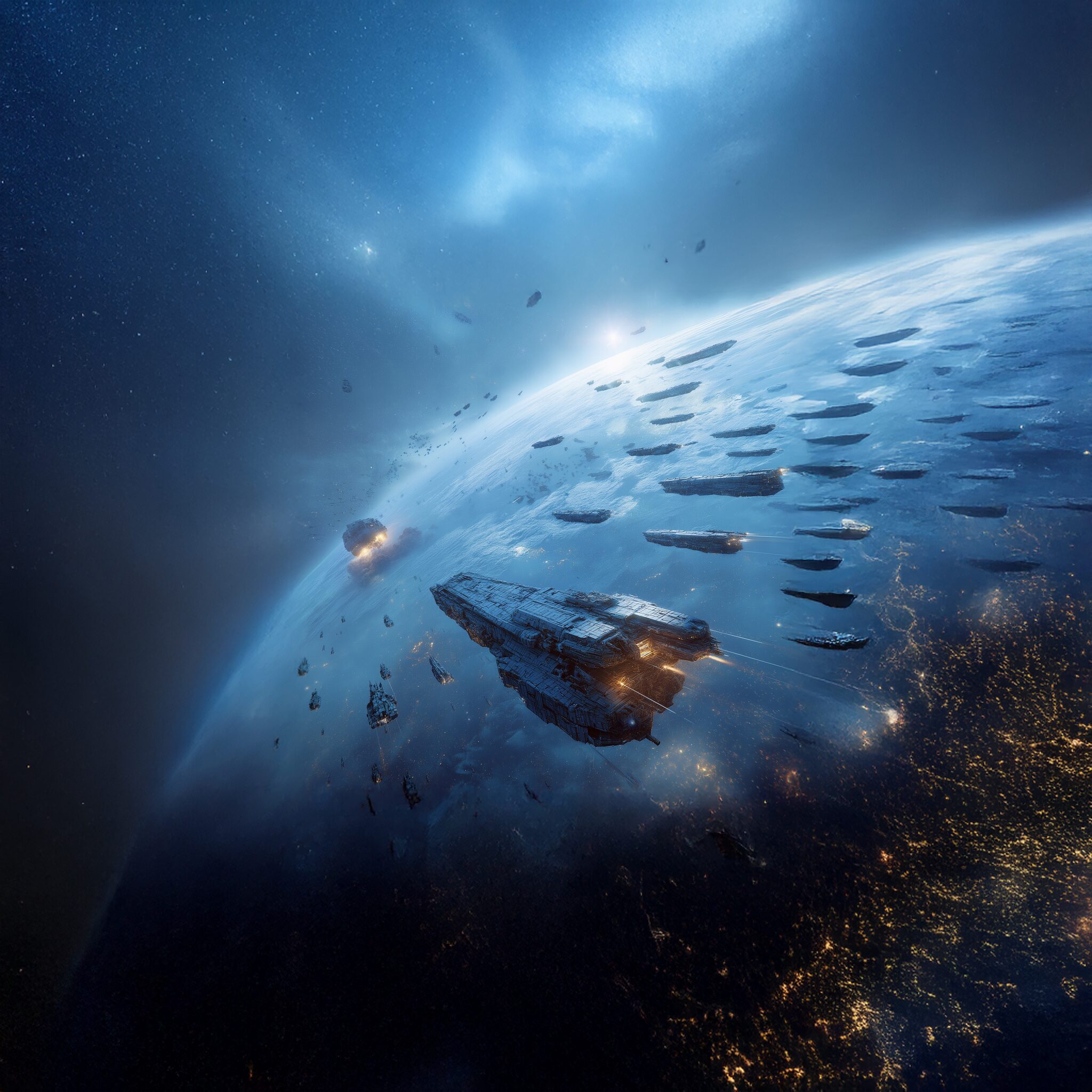
A non-player character (NPC), also called an encounter, is a target in the galaxy that nobody controls. An NPC holds ships, defenses and resources and sits in a slot waiting to be shot at. It never attacks anyone, never colonizes and never joins an alliance.
They exist so there is always something worth flying at. Small and mid-sized players get targets their own size to learn hunting on and to grow off, and everyone else gets more to do than wait for a neighbor to leave a fleet parked.
Where you find them
NPCs turn up in the Galaxy view. They take a slot the same way a planet does, but the row is shaded green and the Player column shows a race name followed by four random characters, like "Krug 38ba". Those four characters are just there to keep the names unique. They are not a rank, a level or a difficulty score.
An NPC row only offers two actions: the eye sends probes and the lightning launches an attack. There is no message, buddy or trade icon, because there is nobody home.
Difficulty colors
The color of the name tells you how hard that fight is for you, not how big the NPC is on its own. Two players looking at the same encounter can see two different colors.
- Gray - Trivial
- Blue - Easy
- Amber - Challenging
- Orange - Dangerous
- Red - Overwhelming
The red warning triangle beside the name is only the encounter marker. It flags the row as an NPC rather than a player planet, and hovering it reads "NPC Encounter". It is not a difficulty or danger rating.
Blue, amber and orange also carry a number from 1 to 100 saying where inside that band the target sits. 1 is the soft end and 100 is the hard end, so a blue 69 is a much heavier fight than a blue 4. Gray and red carry no number. Red is open ended, so a red target might be three times your size or three thousand times your size.
The comparison is against your Resources Spent, halved first. Roughly half of what a player spends goes into mines, buildings and techs that never fire a shot, while an NPC puts everything it has into fleet and defenses. Halving your score is what makes the two comparable.
If you own a moon with an Oracle on it you can sweep whole blocks of solar systems for encounters and filter the results by difficulty band, instead of paging through the Galaxy view one system at a time.
How they spawn
The game places new encounters every 15 minutes. It walks each galaxy in blocks of 50 solar systems and aims for roughly one encounter per active player planet in the block. A single solar system never holds more than four at a time.
Each new encounter is sized against a real player. The game picks an active player with a planet in that block, builds the NPC to match, and most of the time drops it in or right next to that player's own solar system. That is why the encounters within reach of you grow as you and your neighbors grow, and why there is no fixed size table anywhere in this page.
To keep the size mix even, the game sorts the active players in a block into resource bands and picks a band at random before it picks a player. Without that step the bottom-heavy player curve would make almost every encounter newbie-sized and larger players would never see a target worth flying at.
Some players are skipped when the game is looking for someone to size an encounter against:
- Anyone still under newbie protection
- Anyone in diplomacy mode or vacation mode
- Anyone who has not logged in for 24 hours
Being skipped only means encounters are not seeded around your own planets. You can still fly out and attack any encounter you can reach.
The three largest players in a universe are handled slightly differently. Their encounters are still built to their size, but they are never placed inside their own solar systems, so those players have to travel for them instead of having apex targets appear on their doorstep.
How their fleets are built
Once a day the game sorts every real player in the universe by Resources Spent and cuts the list into 20 equal buckets. For each bucket it stores the average weapons, shield and armor level and the average mix of ships and defenses those players own.
When an encounter spawns it takes its combat tech and its unit mix from the bucket matching the player it was sized against, then spends its fleet budget in those proportions. That is why NPC fleets look like player fleets, and why they quietly get tougher over time without anybody editing them.
A few things are held back from the mix. You will never find probes, colony ships, recyclers, a Hephaestus platform or a Zeus Class parked on an encounter, and the game also skips any ship or defense that no player in that universe has built yet.
The loot is set when the encounter spawns. On the ordinary tiers it scales off the size of the player the encounter was built against, with a ceiling so a small tier can never end up sitting on a whale-sized pile. The big extended tiers carry a fixed range set by the tier itself. Either way, roughly half the pile is ore, about a third is crystal and the rest is hydrogen.
How long they last
Every encounter is temporary. The smallest ones sit for about five hours. The biggest ones last close to a full day. There is no "preparing to leave" warning in an espionage report, so if you have found a target worth taking, take it.
An encounter also disappears early once it has been looted down to about a quarter of the resources it started with. One that two or three other people have already worked over will vanish well before its clock runs out.
Scouting one
The eye icon sends probes. The espionage report lists resources, fleet, defenses and combat tech.
NPCs have no buildings, so that section of the report is always empty. They also have no espionage tech of their own, so once you have Espionage Tech at level 2 or higher the counterespionage chance reads 0.0 percent and your probes always come home.
Attacking one
The lightning icon launches the attack. The fight itself runs on the same combat rules as a fight against a player. The differences are all in what happens around it:
- Newbie protection and the rank ratio are both ignored. Any player can attack any encounter they can reach.
- The bashing limit does not apply. Hit the same encounter as many times as you like until it is empty.
- PVE Mode does not stop you. Encounters are not players, so a PVE account can farm them normally.
- Diplomacy mode does stop you. While you are in diplomacy mode you cannot launch any attack at all, encounters included. The attack icon still shows on the row, it just fails when you send.
- Plunder is capped at half of what is sitting on the target, the same as a normal raid, and your cargo space caps it again.
- Ships destroyed on both sides leave a harvestable debris field. Defenses do not.
- Destroyed Ship Points you earn off an encounter count at half rate. The points the encounter earns for the ships you lose are not halved.
- An encounter can never give you a moon, however large the debris field is.
- A win only counts toward the "attacks won" quest counters if the target had at least 100 units defending it. Popping a one-ship wreck does not tick those.
Missile strikes
By default interplanetary missiles cannot lock onto an encounter at all. Encounters are meant to be dealt with by fleet. The one exception is the Siege Missile Codes alliance perk. An alliance that owns it can fire missiles at encounters, but only at ones showing as Trivial or Easy, and only inside normal missile range. Encounters also carry a small amount of anti-ballistic missile cover of their own, so part of the salvo gets intercepted.
Encounter types
There is no table of resource or fleet ranges for encounters, because every one of them is built against a live player. As players grow, so do their encounters. If a wave of new players arrives, the mix skews smaller again until they catch up.
What is fixed is the ladder of names. These are the original encounters, smallest first. Not every race carries every rung.
- Abandoned Cruiser
- Abandoned Warship
- Small Enemy Fleet
- Large Abandoned Warship
- Enemy Fleet
- Large Enemy Fleet
- Abandoned Leviathan
- Floating Colony
- Large Abandoned Leviathan
- Abandoned Colossus Platform
- Large Floating Colony
Above those the ladder keeps climbing, and every rung carries a race name in front of it. The race sets how heavy that rung is, so a Seeker Citadel is a materially bigger fight than a Krug Citadel. These only begin showing up once your Resources Spent is high enough to draw them, smallest first again. The last of the rungs above starts around 600,000 Resources Spent and the first of these, a Krug Dreadnought, starts around 1,560,000, so there is a real gap before they appear at all:
- Dreadnought
- Behemoth
- Citadel
- Leviathan
- Worldbreaker
- Annihilator
- Eclipse
- Voidlord
- Titan
- Juggernaut
- Nemesis
- Cataclysm
- Ragnarok
- Apocalypse
- Oblivion
- Eternity
- Omega
- Zenith
- Sovereign
- Apotheosis
- Infinity
You never see the whole ladder at once. The game draws from a window near your own size, so the small rungs drop off the bottom as new ones open up at the top.
Roughly one in ten of the upper-tier spawns comes out as an Armada instead, for example "Krug Zenith Armada". An Armada is the same rung of the ladder, but it carries no defenses at all and puts its whole budget into ships. Ships leave debris and defenses do not, so an Armada leaves a much bigger debris field behind when you break it.
Above Seeker Infinity
Seeker Infinity is the top named rung, at about 3.56 quintillion Resources Spent. Once a player grows past it, the game keeps spawning targets for them by numbering copies of it: Seeker Infinity II, III, IV and so on. Each numbered rung is five times the size of the one before it.
| Rung | Resources Spent needed |
|---|---|
| Seeker Infinity | 3.56 quintillion |
| II | 17.8 quintillion |
| III | 89 quintillion |
| IV | 445 quintillion |
| V | 2.2 sextillion |
| VI | 11.1 sextillion |
| VII | 55.6 sextillion |
| VIII | 278 sextillion |
| IX | 1.39 septillion |
| X | 6.95 septillion |
The threshold is measured against the Resources Spent of the player an encounter is sized against, not yours. An encounter sized against a player spawns at the highest rung that player's Resources Spent reaches, or the rung just below it. A rung therefore only appears in a block of solar systems once someone with a planet in that block has reached it. The larger the rung, the fewer players can anchor it, so the big rungs are rare and cluster around the few players large enough to draw them. The three largest players' encounters spawn away from their own solar systems, so those are where most of the top rungs come from.
Loot on rungs II through VII grows at the same rate as their size. From VIII upward each rung is five times harder than the last but carries 4.75 times the loot, so loot per unit of fleet drops about 5% per rung. The number of encounters that spawn is not reduced at any rung.
The three races
Every encounter belongs to one of three fictional races. The race decides the name and which rungs of the ladder are on offer. It also sets the weight. At the same rung name, Krug is the lightest, Urcath sits about a third above it, and Seekers are the heaviest, so read the race as well as the name before you commit a fleet.
- Krug - A ruthless race of hulking, barbaric warriors whose heritage and culture center on combat and brutality. They pillage defenseless colonies and stranded fleets, and they always shoot first and ask questions later. Not much is known about them, because the people who meet them rarely live to tell the tale.
- Urcath - These vile beings cannot be approached with any form of negotiation or reason, and have to be pushed back with brute force. They show no sign of speech, yet they coordinate with a surprising level of strategic unity, which makes them a vicious adversary.
- Seekers - A colossal race of supremely intelligent beings that once ruled over most of the known universe. The Seekers are now extinct, and their existence is only hinted at by the trace artifacts still drifting through the galaxy.
Secret missions
Encounters also fill secret missions, which draw from the same catalog. Those ones sit in a galaxy only you can reach, so nobody else can pick them clean before you get there.
Comments
No comments yet.
Show 6 resolved comments
From a post in the forum, the new NPCs are
newer extended tiers: Dreadnought, Behemoth, Citadel, Leviathan, Worldbreaker, Annihilator, Eclipse, Voidlord, Titan, Juggernaut, Nemesis, Cataclysm, Ragnarok, Apocalypse, Oblivion, Eternity, Omega. Each comes in Krug, Urcath, and Seeker versions, in that order of strength.
Please add the new NPC types.
What does the red triangle with the (!) mean?
Those NPCs listed are v1 NPCs based on percentiles... They work differently in v2 and are bracketed by rsp rather than dynamic. This needs updating...
Also the newly introduced encounters dont have rsp brackets assigned. This, too, needs clarifying and updating
Also john or chad mentioned that they spawn every 15 mins, on the wiki it says hourly.
The npcs disappear when you fully plunder them twice meaning 75% has been plundered and not 85% as per the npc wiki, the wiki should be updated to reflect that %.
Sign in to leave a comment.