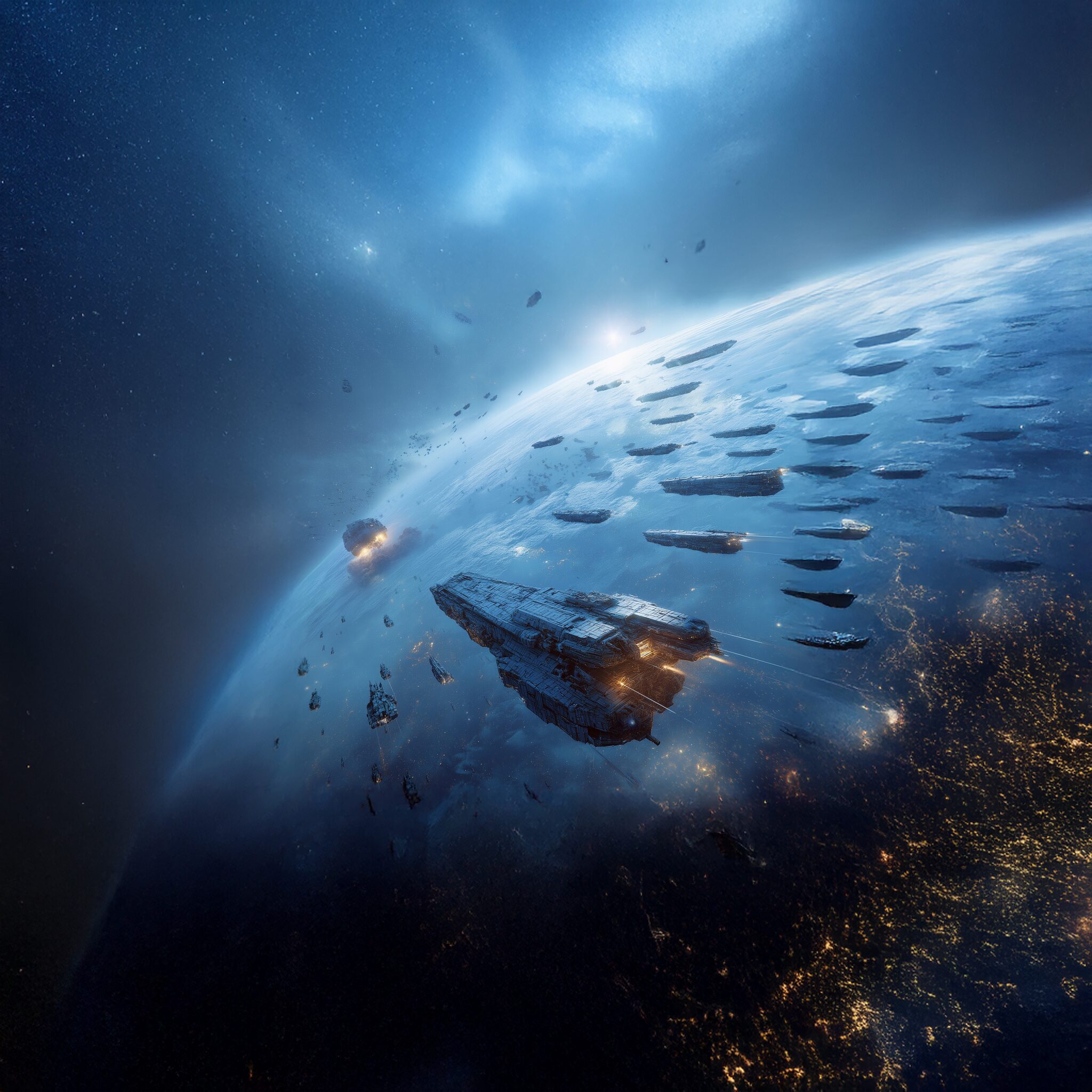
A Mobile Assault Colony, usually just called a MAC, is an ordinary colony planted next to somebody you want to hit. There is no MAC building and no MAC button in SFC2. It is a Gaia Class Colony Ship sent to an empty slot in someone else's neighbourhood with a war fleet riding along, and everything that lands there stays there.
It is the cheap answer to the Hephaestus Class Attack Platform. It costs 40,000 resources instead of 50,000,000, you can run more than one, and nobody can take it off the board. What it cannot do is move.
Why bother
Distance is what makes raiding expensive. The same 200 Athena sent at the same target, once from a homeworld two galaxies away and once from a colony sitting two slots from the target:
| Sent from | Distance | Travel time at 100% | Hydrogen |
|---|---|---|---|
| Homeworld at 1:4:13 | 40,000 | 2h 41m | 457,143 |
| MAC in the target's own system | 1,010 | 25m | 11,543 |
Forty times the fuel and six times the wait, for the same fleet hitting the same planet. You still pay the long trip once, when you fly the colony ship out. After that every run is the cheap one. Times assume Warp Drive 14; lower levels are slower but the ratio holds.
The other half of it is warning. A fleet crossing two galaxies gives the target hours to see it coming and empty the planet. A fleet leaving a slot in the same system does not.
Setting one up
All you need is a Gaia Class Colony Ship, which means Shipyard 4 and Pulse Drive 3. No Foundry, no Warp Drive, no Expedition Tech. Most commanders can field their first MAC long before they can even see a Hephaestus on the Shipyard page.
- Open the Galaxy page and find the system you want to sit in.
- Click the flag icon in the Actions column on an empty slot.
- Load the Gaia, whatever you want stationed there, and any resources you want it to start with.
- Dispatch.

Everything you send with the Gaia is stationed at the new colony when it lands. The escorts do not turn around, and the cargo is unloaded into the new planet's store. Only the Gaia is used up. The colonization report you get back lists exactly what stayed behind.
Two things to plan for on that first trip:
- The fleet moves at the pace of its slowest ship, and the Gaia is one of the slowest things in the game. Expect the setup run to take a lot longer than the raids it enables.
- The Gaia burns 1,000 fuel, the worst rate in the game. Crossing galaxies with one is not cheap.
Fields are rolled from the slot number, not from where you launched. Slots 4, 5 and 6 land at roughly 130 to 250 fields, slots 1 to 3 at about 70 to 110. The Gaia Class Colony Ship page has the full table. A MAC does not need many fields, but there is no reason to take a bad slot when a good one is free in the same system.
It costs you a planet slot
You get 10 planets, and a MAC is a planet. That is the real price, not the 40,000 resources. A slot holding a forward base is a slot not holding a mining colony with a moon and an Oracle on it. Moons do not count against the 10, so a MAC that grows one is not costing you twice.
A deployed Hephaestus does not use a planet slot at all. If you ever own one, that is the difference that matters most.
What you can build on it
A MAC is a normal planet, so everything works: mines, power, Shipyard, defenses, Missile Silo, Research Lab, Resource Den, warehouses, missions, the lot. It also rolls for a moon on battle debris like any other planet. A platform can do none of that.
Most people keep a MAC thin. Enough mines and power to feed a Shipyard turning out fodder, a Missile Silo, and only as much defence as they are willing to write off when they move on. Everything you build there is lost the day you leave.

Missiles from the doorstep
Interplanetary Ballistic Missiles reach (5 x Pulse Drive level) - 1 solar systems, and only inside your own galaxy. Pulse Drive 1 already covers four systems in each direction, so a MAC covers its own system and a good slice of the ones either side without any extra research at all.
You need Missile Silo 4 to build IPBMs, and each one takes two silo slots, so a silo holds five IPBMs per level. At distance 0 the flight takes 30 seconds.

This is the clearest thing a MAC does that a Hephaestus cannot. A platform cannot build a Missile Silo, and missile strikes cannot be aimed at one either.
Evaluation
Advantages
- Cheap and early. 40,000 resources and two low requirements, against 50,000,000 and a research list that includes Shipyard 13, Foundry 3, three techs at 12, Particle Tech 10, Warp Drive 9 and Expedition Tech 8.
- You can have several. Only one Hephaestus may exist per account at a time. MACs are limited only by your 10 planet slots.
- It cannot be destroyed. Nothing in SFC2 removes a planet from the board. Your MAC can be spied, raided, missiled and stripped, but it is still yours the next morning. A platform dies in a single lost battle and takes every ship on it with it, plus any fleet due to return to it.
- It is a real planet. It produces resources, builds ships and defenses, researches, runs missions and can grow a moon.
- Long jobs are safe. A slow mission launched from a platform is what gets platforms killed, because the base has to sit still and wait. A MAC is going to be there whatever happens.
- It makes its own hydrogen. A platform makes none, so everything it burns had to be flown in.
- It hits targets people think are safe. Quiet corners of the universe are quiet because nobody lives close enough to bother. A MAC fixes that.
Disadvantages
- It never moves. Not slowly, not for a price. The only way to relocate a MAC is to fly the fleet somewhere else and abandon the colony, and everything you built on it goes with it.
- It eats one of your 10 planet slots, for as long as it exists.
- The escorts pay full fare. Ships flying out with the Gaia are an ordinary fleet paying ordinary fuel. Ships parked on a Hephaestus ride along for free every time it moves.
- No hull, no shield. A MAC has no combat stats of its own. Everything defending it is either a ship parked there or a defense you paid to build and will eventually abandon.
- It can be hit like any planet. Spied, raided, missiled and moon shot. A platform cannot be targeted by missiles at all.
- Storage is whatever you build. A new colony holds very little until the warehouses go up. A Hephaestus holds a billion of each resource on day one.
- Ships parked there still need fleet saving when you are away, and that costs hydrogen it has to produce or be sent.
- Everybody sees it arrive. It shows in the Galaxy list the moment it lands, next door to people who now have a reason to look at you.
Rules that still apply
Being close to a target does not buy you anything the rest of the game would not allow:
- Bashing limit: six attacks on the same planet in any 24 hours, however short the trip is.
- Rank range: you cannot attack someone far below you. The dispatch page just says "Ranks are too far apart to attack this player". Newbie protection blocks the bottom of the ladder entirely.
- Diplomacy Mode, Vacation Mode and PVE Mode all still shut you out.
- Planting a colony in someone's system is fair play. Grinding one player down day after day is not, and the Rules cover it whichever direction your fleet came from.
Moving on
When the neighbourhood runs out of targets, a MAC is dead weight sitting on a planet slot. Getting out of it is a one way door:
- Send the fleet somewhere else with Deploy, and the resources out with Transport. Anything still on the planet is destroyed.
- Wait for every fleet you launched from it to land. A planet with missions still running cannot be abandoned.
- Open Overview on that planet and click Abandon.

The confirmation asks you to type ABANDON followed by the planet's name, so a slip of the mouse on the wrong planet is caught before anything happens. The warning lists the resources and the moveable ships you are about to throw away.
Everything left behind is gone for good: buildings, mines, defenses, missiles, ships and stored resources. If a moon grew at that slot it is destroyed in the same stroke. The slot goes empty and anybody can colonize it. You cannot abandon your last remaining planet.
Comments
No comments yet.
Sign in to leave a comment.